
Drone threats are a growing operational concern across military, law enforcement and security environments. From reconnaissance and smuggling to disruption at events, critical sites and coordinated attacks on personnel and infrastructure, unmanned aerial systems (UAS) are now something every operational organisation needs to plan for.
AVRT’s Counter-UAS VR Training System enables personnel to rehearse drone threat detection, identification and response procedures within realistic, immersive scenarios, without the cost, risk or logistical burden of live drone exercises.
Using configurable virtual environments, teams can train against dynamic UAS threats while integrating communication, tactical movement, equipment handling and decision-making under pressure.
AVRT integrates Counter-UAS training directly into operational scenarios, allowing personnel to respond to drone threats within realistic mission environments rather than isolated simulations.
Whether defending infrastructure, conducting patrols, securing an event or responding to an active threat, operators can rehearse procedures against configurable drone behaviours in repeatable virtual exercises.
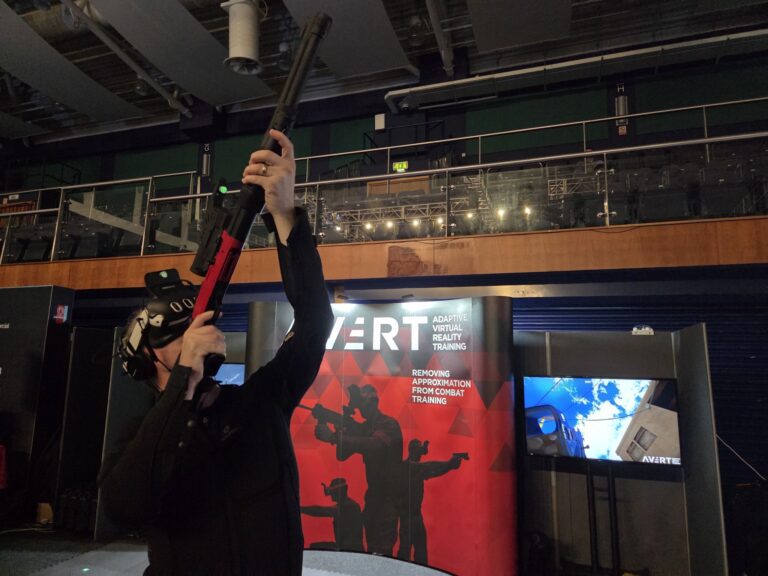
Counter-UAS response is rarely an individual task.
AVRT supports multi-user training exercises that allow teams to coordinate communication, tracking, engagement and tactical decision-making within shared virtual environments.
Personnel can rehearse:
Train personnel to recognise, assess and respond to unmanned aerial threats in realistic operational environments.
AVRT scenarios can simulate varying drone types, behaviours and threat profiles, helping users develop situational awareness and rapid decision-making skills under pressure.
Unlike standalone drone simulators, AVRT embeds Counter-UAS threats directly into wider tactical exercises.
Personnel can train for drone encounters during:
This creates more realistic and operationally relevant rehearsals.
Live Counter-UAS exercises are expensive, restricted by airspace regulations and difficult to scale.
AVRT provides a safe and repeatable synthetic training environment that removes the need for:
This allows organisations to conduct more frequent and accessible Counter-UAS rehearsals.
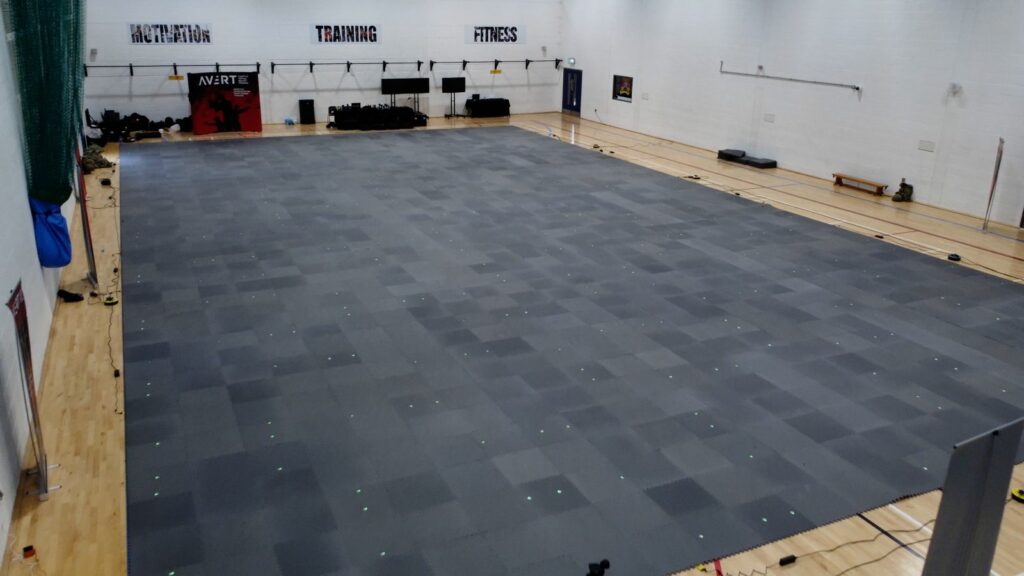
Drone characteristics and behaviours can be adjusted to match different operational requirements.
Training scenarios can include:
This flexibility allows organisations to tailor training to evolving threats and mission objectives.
Every exercise can be reviewed and analysed to improve operational performance.
AVRT’s after action review capabilities allow instructors and trainees to assess:
This supports measurable skill development and continuous improvement.
Traditional drone training exercises are resource-intensive and difficult to repeat consistently.
Virtual reality training allows organisations to:
AVRT helps organisations prepare personnel for modern operational challenges within scalable and immersive synthetic environments.
AVRT Counter-UAS training can support a wide range of operational requirements, including:
Counter-UAS training prepares personnel to detect, identify, track and respond to unmanned aerial system (UAS) threats using tactical procedures, technology and operational decision-making.
Yes. AVRT supports multi-user training exercises that allow teams to rehearse communication, coordination and response procedures together.
No. AVRT provides a fully virtual synthetic training environment, removing the need for live drone exercises and airspace restrictions.
Yes. Scenarios, drone behaviours, environmental conditions and operational objectives can be configured to suit specific training requirements.
This website uses cookies
We use cookies and other tracking technologies to improve your browsing experience on our website, to show you personalised content and targeted ads, to analyse our website traffic, and to understand where our visitors are coming from. By browsing our website, you consent to our use of cookies and other tracking technologies.