Counter-UAS Training for Infantry: What Dismounted Units Need
Drones are no longer just a problem for fixed bases and air defence crews. For infantry on patrol, in defence or moving between cover, a small drone overhead can mean surveillance, a strike, or both within seconds. That changes what counter-UAS training needs to look like.
The US Army’s 2d Cavalry Regiment is a recent example. Its Project Flytrap initiative has grown from platoon exercises in Germany into larger trials across Poland and Lithuania, where troops used more than 50 counter-drone and unmanned systems over 90 hours of continuous manoeuvre, and it is now being expanded to battalion level. Read the full story on army.mil, or see our news story on Project Flytrap.
Why infantry face a different problem
Fixed-site defence can rely on equipment that stays put and crews who watch the sky as their main job. Dismounted infantry have neither luxury. They are moving, carrying out other tasks, and often have very little warning.
- Short reaction windows. A drone can appear, identify a position and attack faster than a unit can reorganise.
- Small, hard-to-spot targets. Drones are often small and can be lost against treelines, buildings or cloud.
- Competing demands. Soldiers still have to keep ground security, communicate and stay in cover while watching for threats overhead.
What Counter-UAS training for infantry should include
Training that prepares infantry for these conditions should cover the whole sequence, not just the moment of engagement.
- Detection and identification: spotting a drone early and recognising what it is and what it is doing.
- Communication: calling out contact, direction and range clearly so the whole fireteam knows.
- Sector coverage: dividing up the sky while still watching the ground.
- Response: using the right kinetic or non-kinetic option and making sound decisions under pressure.
- Movement and cover: keeping spacing, moving between positions and taking cover as part of the drill.
- Review: looking back at what was seen, how quickly and how the team reacted.C
Why standing still falls short
Counter-UAS drills that are separated from movement can teach the technique but not the context. In real operations, the drone arrives in the middle of everything else the unit is doing. If the first time a fireteam deals with that is on live operations, they are working it out as it happens.
Mixing counter-UAS threats into normal tactical training lets units practise detecting and responding while they move, communicate and manage everything else at the same time. It also gives instructors a way to see where the team’s attention and coordination break down.
Where free-roam VR fits
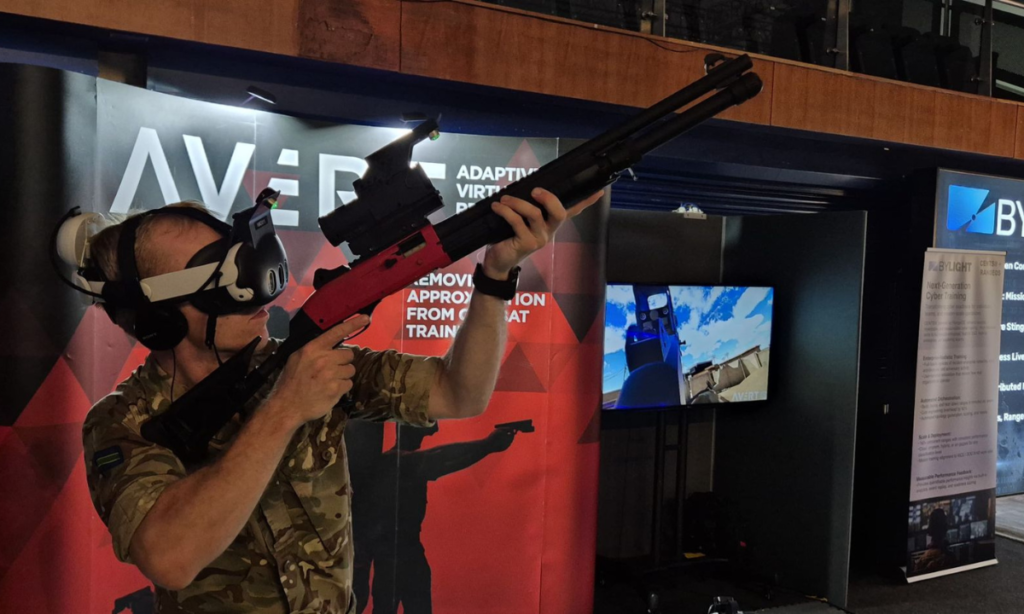
This is how AVRT approaches counter-UAS training. Instead of a standalone drone simulator, threats are built into free-roam scenarios, so fireteams and squads move naturally through the space while drones appear around them.
- Configurable threats: instructors can set drone types, attack profiles and numbers, including swarming and direct attack.
- Multi-user training: teams rehearse communication, coordination and response together.
- Simulated responses: kinetic and non-kinetic options can be trained within the same scenario.
- After action review: instructors can review detection times, engagement decisions and tactical movement afterwards.
- No live drones: training does not need live drone operations, airspace approvals or weather windows, so it can be repeated as often as required.
Find out more about Counter-UAS VR Training with AVRT.
What to look for in a training system
If you are comparing options for infantry counter-UAS training, these questions are a useful starting point.
- Can personnel move naturally, rather than stand in one place?
- Can a whole team train together?
- Can the instructor control and change the drone threat?
- Does the system record data that supports a proper review?
- Is it portable enough to use where and when your unit trains?