
Counter-UAS Training: Preparing Your Teams for the Drone Threat
Drones have moved from a niche concern to one of the most urgent capability gaps facing military and security forces today. A recent whitepaper from DroneSec and the Center for Internet Security (CIS) sets out just how fast the threat is evolving, examining the risks uncrewed aircraft now pose to major operations and large-scale public events, including upcoming FIFA fixtures.
The scale of the response underway confirms it. The UK’s June 2026 Defence Investment Plan commits more than £5 billion to drones and autonomous systems over four years, including over £750 million specifically for short-range counter-drone systems. At the alliance level, NATO has approved a $40 billion counter-drone initiative to strengthen Allied defences against low-cost UAV threats, citing a rising number of drone incidents affecting member states, particularly along the eastern flank.
AVRT changes how personnel prepare for that threat.
The Problem With Training for a Moving Target
Static briefings and slide decks can only take a team so far when the threat itself changes month to month. New drone platforms, new tactics, and new countermeasures emerge faster than most training cycles can keep up with, leaving personnel practising against a threat picture that’s already out of date by the time they deploy.
This isn’t just an equipment problem. Coverage of NATO’s own counter-drone expansion points to a training burden that goes well beyond simply fielding new hardware, including the need for operators to classify small targets under pressure, avoid engaging friendly systems, and choose correctly between jamming and kinetic responses, often within tight legal and procedural constraints. Building that judgement takes repeated, realistic practice, not a one-off briefing.
| Traditional Threat Training | AVRT Counter-UAS Training | |
|---|---|---|
| Content updates | Fixed until next review cycle | Adapted as threats evolve |
| Repetition | Limited by cost, range time, resources | Unlimited, low marginal cost |
| Realism | Briefings, slides, static exercises | Immersive, free-roam, real-world weapons |
| Assessment | Manual, instructor-dependent | Data-driven: positioning, response time, decisions |
How AVRT’s Counter-UAS Training Works
AVRT’s Counter-UAS (CUAS) training capability is built directly on the existing AVRT platform, giving trainees a safe, repeatable, easy-to-assess environment to build the full range of skills the threat demands:
- Identification of drone threats in real time
- Correct procedure and escalation response
- Evasion techniques
- Counter-UAS weapon handling and engagement
Because scenarios run on AVRT’s adaptive, instructor-led engine, training content can be updated and repeated as drone tactics and technology change, keeping personnel current rather than training against yesterday’s threat.
Proven at Scale
AVRT’s Counter-UAS training isn’t a standalone add-on, it’s built on a platform already trusted by military and law enforcement organisations worldwide. The core AVRT system has been developed with feedback from over 5,000 military and law enforcement personnel, and is currently deployed with forces including the Singapore Army. That same platform, and the same cost advantages over traditional training, now extends to Counter-UAS.
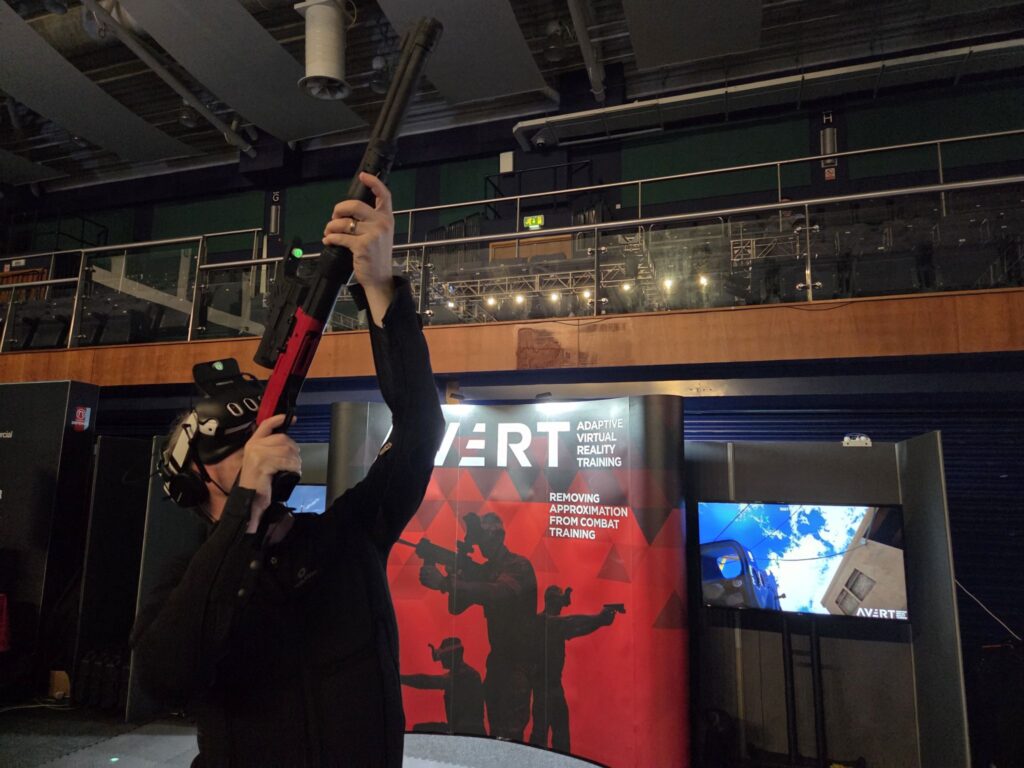
The CUAS capability had its first public demonstration at DSET 2026, the UK’s leading defence simulation, education and training conference, where it drew strong interest from serving military personnel for its realistic, tactical approach to counter-drone response.
Built for Military and Security Operations
AVRT’s CUAS training sits within the same platform already used across military and law enforcement training, combining real-world weapons, free-roam movement, and instructor-led scenario control. It’s designed to fit into existing curricula and training frameworks rather than requiring a separate system to manage.
See Counter-UAS Training in Action
Drone threats won’t wait for the next training review cycle. Book a live Counter-UAS training demonstration and see how AVRT prepares your teams to identify, evade, and respond to the drone threat, or contact us directly at info@avrt.training to discuss your requirement.