
UK Defence Budget Squeeze Puts Training Efficiency in the Spotlight
30, October 2026 – In this week’s Budget, Chancellor John Healey committed the UK to spending 3% of GDP on defence by 2030, with full details of how the government will reach NATO’s 3.5% target by 2035 due at next year’s spending review. The Office for Budget Responsibility puts the extra cost of the 3% step at £17.3 billion in 2029 to 30, and the government says part of a £4.7 billion shortfall in the Defence Investment Plan will be met by trimming departmental capital budgets and drawing on a Treasury contingency reserve. Opposition leader Kemi Badenoch dismissed the announcement as “a plan to have a plan,” while former Defence Secretary Sir Ben Wallace warned of a real terms cut to day to day spending next year.
The US Army’s 2d Cavalry Regiment is a recent example. Its Project Flytrap initiative has grown from platoon exercises in Germany into larger trials across Poland and Lithuania, where troops used more than 50 counter-drone and unmanned systems over 90 hours of continuous manoeuvre, and it is now being expanded to battalion level. Read the full story on army.mil, or see our news story on Project Flytrap.
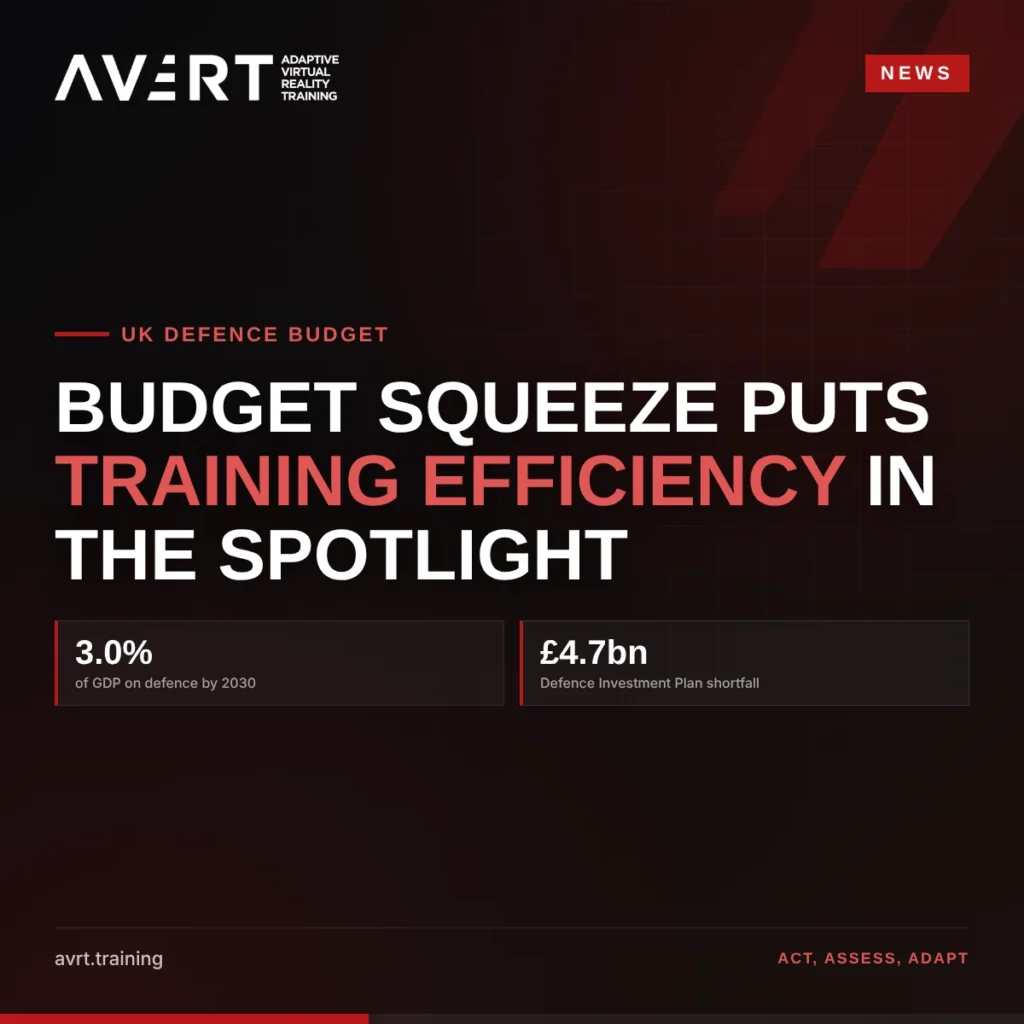
Funding a defence spending increase partly by trimming capital budgets means forces have to get more training value out of every pound, not less. When equipment, range time and facility budgets are under this kind of pressure, it lands squarely on training capacity: more personnel need to reach readiness, without a matching rise in ammunition, logistics or infrastructure spend.
This is the gap AVRT’s VR military training system is built for. The free roam platform tracks multiple users at once for section and platoon level exercises, needs no ongoing calibration or specialist operators once installed, and cuts the live ammunition and logistics costs that usually scale with every extra repetition. For units trying to protect training throughput while their wider budgets tighten, that difference compounds fast.
It also means training content doesn’t have to wait on next year’s procurement cycle. AVRT’s Scenario Flexibility capability lets instructors build and adjust scenarios in house, mixing live instructor control with AI driven actors, so units can keep pace with new threats and changing priorities without a new contract every time the requirement shifts.
If you believe that our platform could be advantageous for your training needs, reach out to us at info@avrt.training or complete our contact form, and a member of the team will be in touch.